

If you work on MLIR-based compilers chances are you heard of linalg dialect.
And if you work on a compiler which uses it (e.g. IREE), then understanding ins and outs of linalg.generic (pun intended) is a prerequisite for the job.
I have read the docs, the rationale, and watched a couple of relevant talks, but still was struggling to understand it.
Until I realized that linalg.generic is just a fancy notation for good old for-loops.
I set myself a goal to convert linalg.generic to a bunch of scf.fors by hand, and this article is a summary of my pen-and-paper exercise.
memref refresher
A side note on
tensors vsmemrefs: depending on which part of the compiler stack you are dealing with, you are more likely to encounter linalg on tensors as opposed to memrefs.
For the purposes of this article I chose to usememrefs as IMO they are a bit easier to work with and we don’t need to be concerned about intricacies oftensorandscf.forAPIs.The topics discussed here apply to both types interchangeably.
Roughly speaking, a memref is a multidimensional memory buffer, similar to C’s void *, but with a bit more metadata attached both at compile and run time:
rank: the number of dimensions thismemref“holds”. Therankis known at compile time (in the context oflinalg, that is).dimension sizeor anextent: either static (non-negative integer) or dynamic (?). Static extent is known at compile time, the dynamic is only known at run time.element_type: this is the underlying type amemrefholds.memref<i32>holds integers,memref<f32>holds floats,memref<vector<8xf64>>holds vectors of doubles.
There are several operations working with memrefs, for this article we only need three of them:
memref.dim(%mem, index): returns the size of a specific dimensionmemref.load(%mem, [indexes]): retrieves a specific valuememref.store(%mem, %new_val, [indexes]): “overrides” a specific value
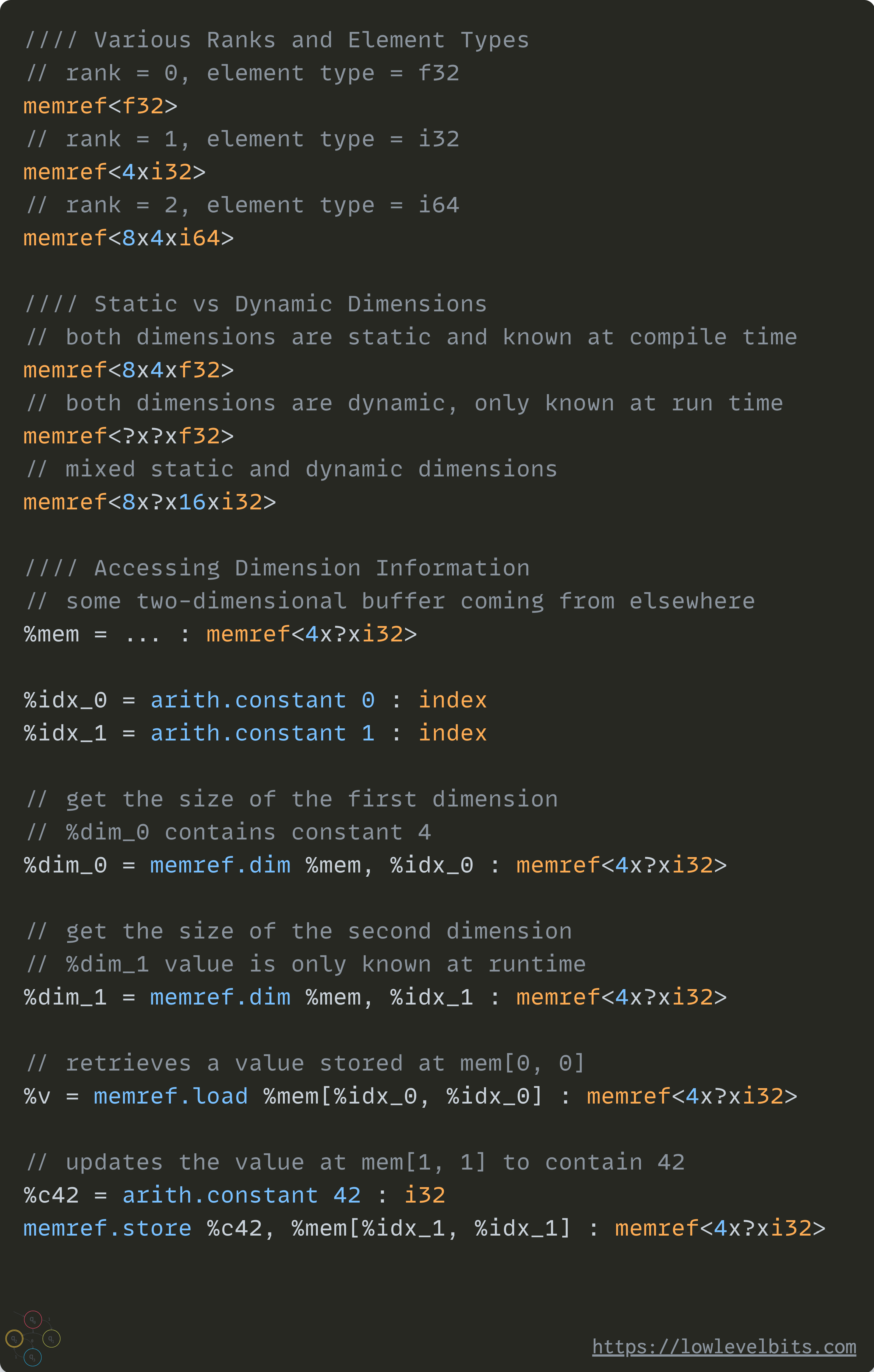
Some examples:
Anatomy of a linalg.generic operation
A linalg.generic operation is a compact representation of K nested loops with N inputs ins and M outputs outs.
It consists of metadata such as indexing_maps with a total number of N+M affine_maps (one for each operand ins and outs), total K iterator_types (one for each loop) and a loop nest (a body) of the inner-most loop. The loop nest accepts N+M operands each corresponding to a specific ins / outs value. The loop nest does some work (possibly nothing) and yields M values “back”.
A linalg.generic operates on memref(or tensor) values with potentially distinct ranks and potentially distinct underlying types (Tin_0, ..., Tin_N, Tout_0,..., Tout_M).
Below is a generic scheme of a linalg.generic:
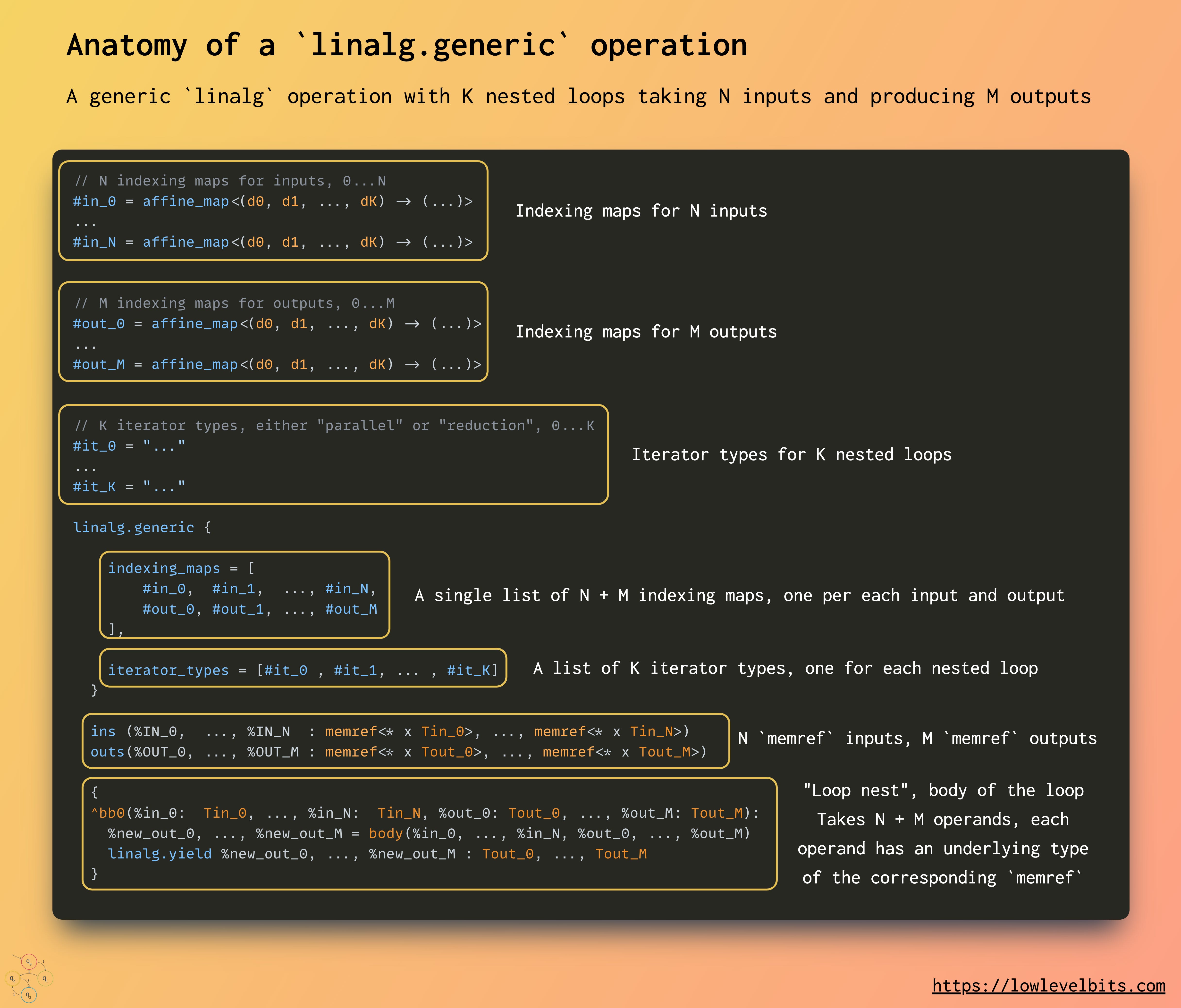
There are a lot of details and now we are going to look into each component in isolation. We do so in reverse order: loop nest, iterator types, and indexing maps.
Loop nest
The loop nest describes precisely what happens to inputs/outputs at each iteration of the loop.
The loop nest is a single (basic) block with N+M block arguments. Each block argument corresponds to a specific ins or outs operand and has the element type of the corresponding linalg.generic operand.
For example:
ins(%A: memref<f32>) outs(%B: memref<f64>) → ^bb0(%a: f32, %b: f64): memrefs with different element typesins(%A: memref<4xf32>) outs(%B: memref<12x14xf64>) → ^bb0(%a: f32, %b: f64): ranks do not matter, block arguments still have element typesins(%A: memref<4xvector<8xf32>>) outs(%B: memref<4xvector<8xf64>>) → ^bb0(%a: vector<8xf32>, %b: vector<8xf64>): element types may be non-scalars
The loop nest always ends with a linalg.yield which itself has exactly M operands, with the same element type as each corresponding outs operand.
Iterator types
The iterator types (parallel or reduction) are defined for each nested loop: they depend on K and not on N or M .
Roughly speaking, they matter most for optimizations, e.g. parallel means that the correctness does not depend on the order in which this specific loop is running, and thus it can be reordered or parallelized.
For the purposes of this article, the exact iterator types can be ignored.
Indexing maps
This is perhaps the most information-dense and thus confusing part, at least its purpose isn’t that obvious by looking at the operation definition.
The indexing_maps provides the following info:
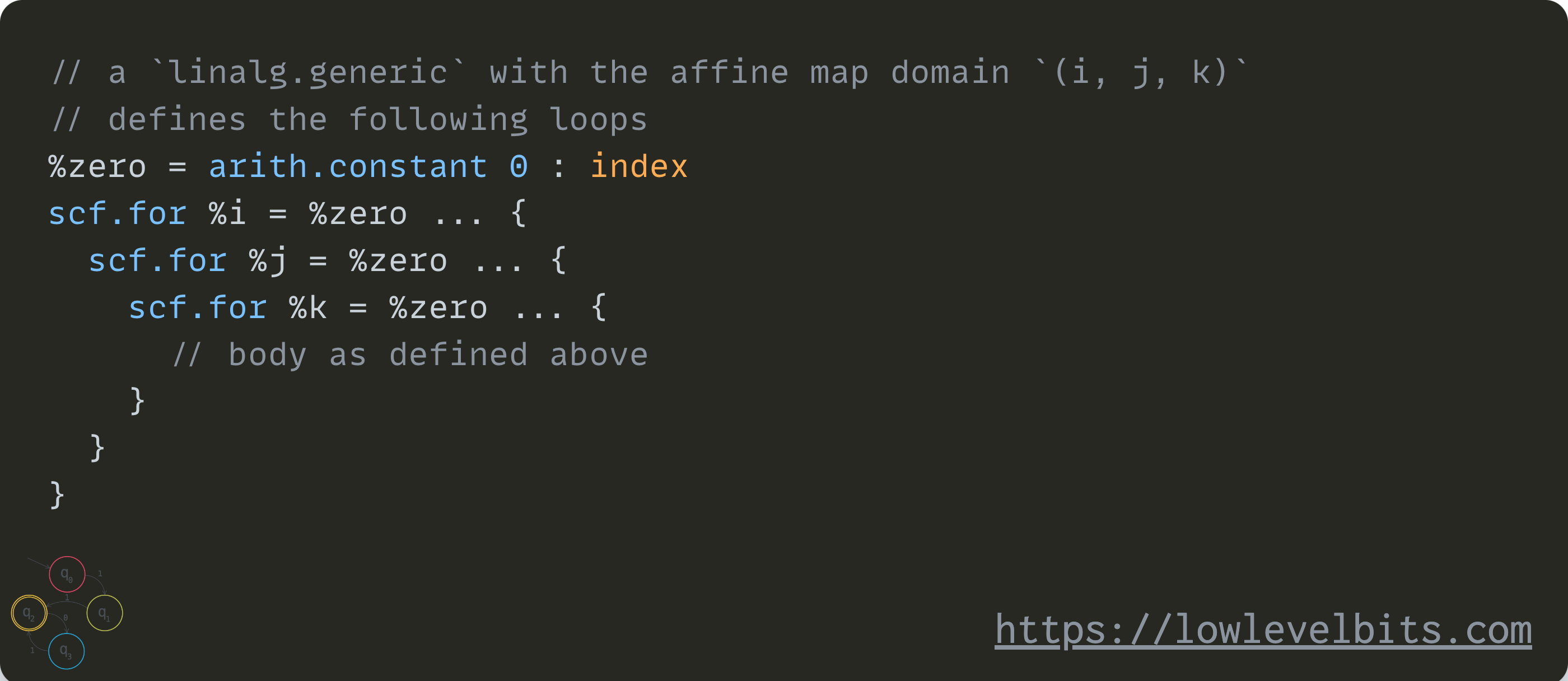
The number of nested loops. All the maps in the array share the same domain (the left-hand side
(d0, d1, …, dK)part), i.e. a specificlinalg.generichasKnested loops. In a way, each dimensiondkcan be seen as an induction variable (an index) of each nested loop. The actual names do not matter:affine_map<(i, j, k) → (…)>is a valid map. Thus, alinalg.genericwith thei, j, kmap represents the following loop:
The address/index computation for each data access.
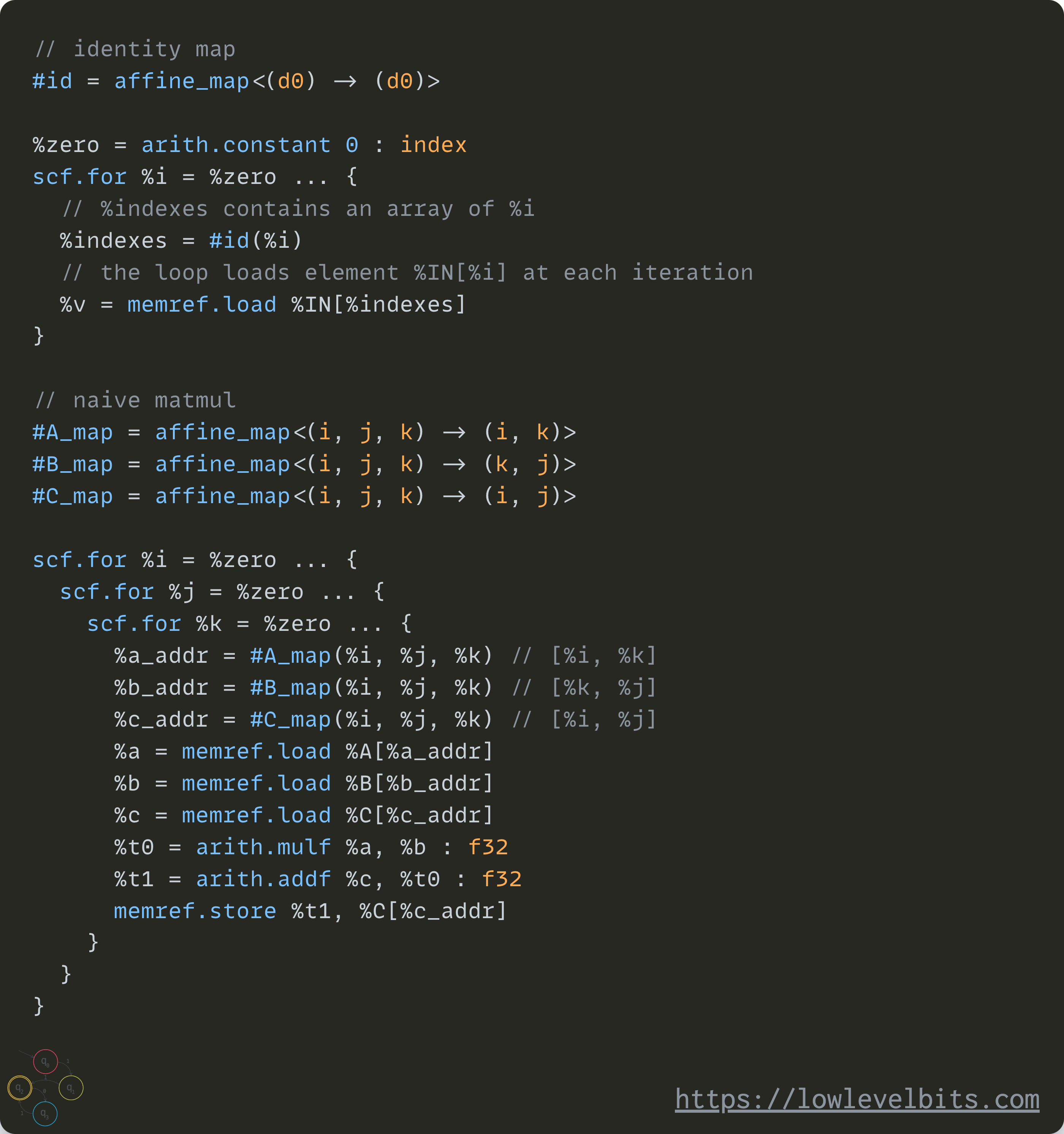
indexing_maparray has an entry for eachlinalg.genericinput and output. In the “anatomy” picture above, each%IN_nhas a corresponding#in_naffine map,%OUT_mhas a map#out_mrespectively. A map acts as a “classical” function e.g.f(x) → y. To compute an address of a value accessed by an iteration of a loop, one needs to apply the affine map/function to the induction variables.In the first example below, an identity map
<(d0) → (d0)>produces the same value:#id(%i) → %i,#id(%j) → %j,#id(42) → 42.
The second example is a matmul using a naïve implementation: there are three nested loops with indexesi, j, k. At each iteration, the loop nest accesses values fromA, B, Cas you’d see in a text book:C[i, j] = A[i, k] * B[k, j] + C[i, j]
Upper bounds for the loops. All the
scf.forso far conveniently omitted the upper bounds in the examples. And the reason is that determining the exact limits for each loop is a bit involved.
Let’s take a look at a matmul example. In this case, there are three operands all of which are 2d matrices of floats:Ashape is4x8,Bshape is8x6andChas a dynamic shape.
Each indexing map corresponds to alinalg.genericoperand, and the number of results of an affine map (the right-hand side after→) equals to the rank of a correspondingmemref. In the example belowm, kcorresponds to4x8,k, ncorresponds to8x6, andm, ncorresponds to?x?.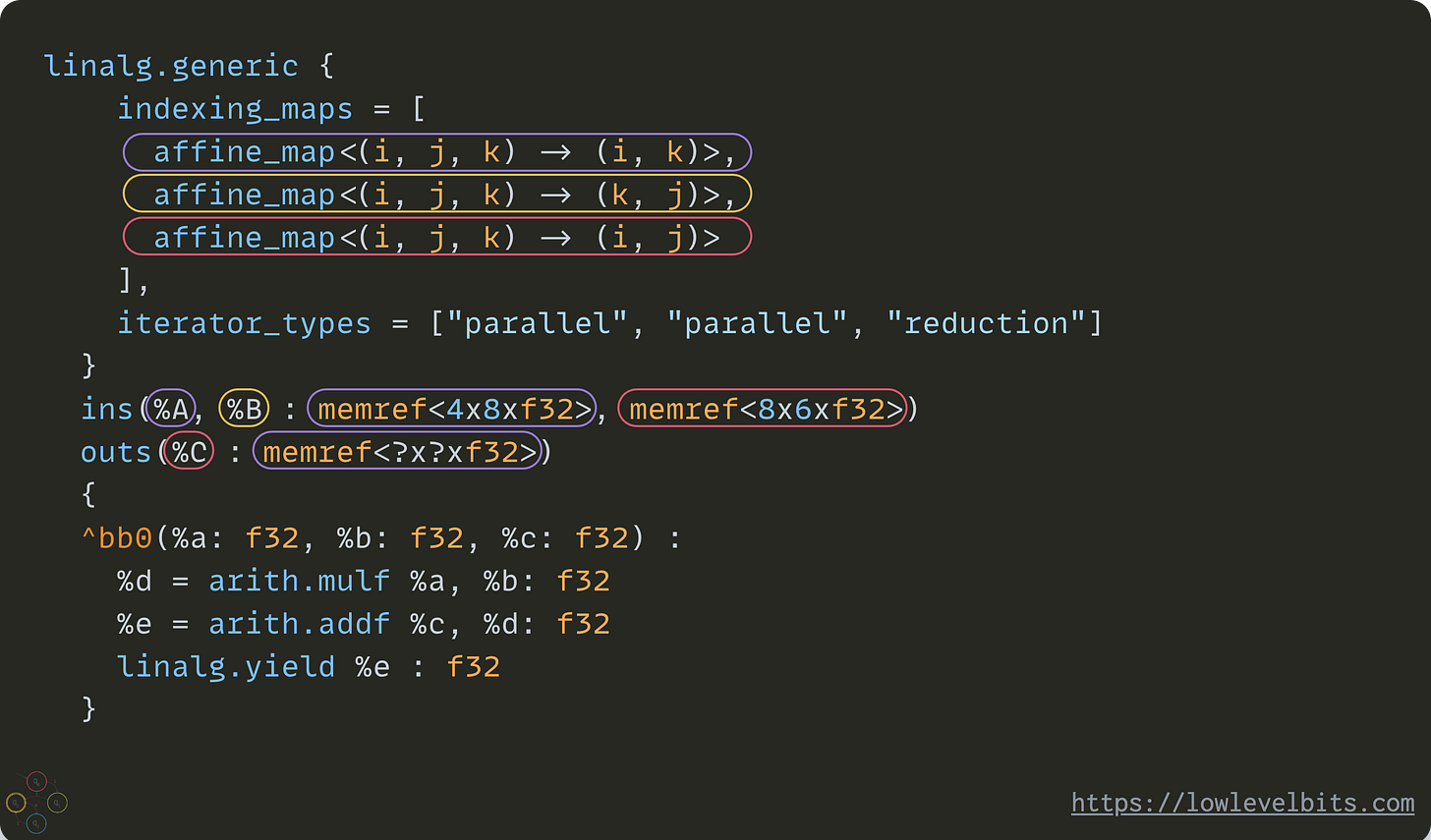
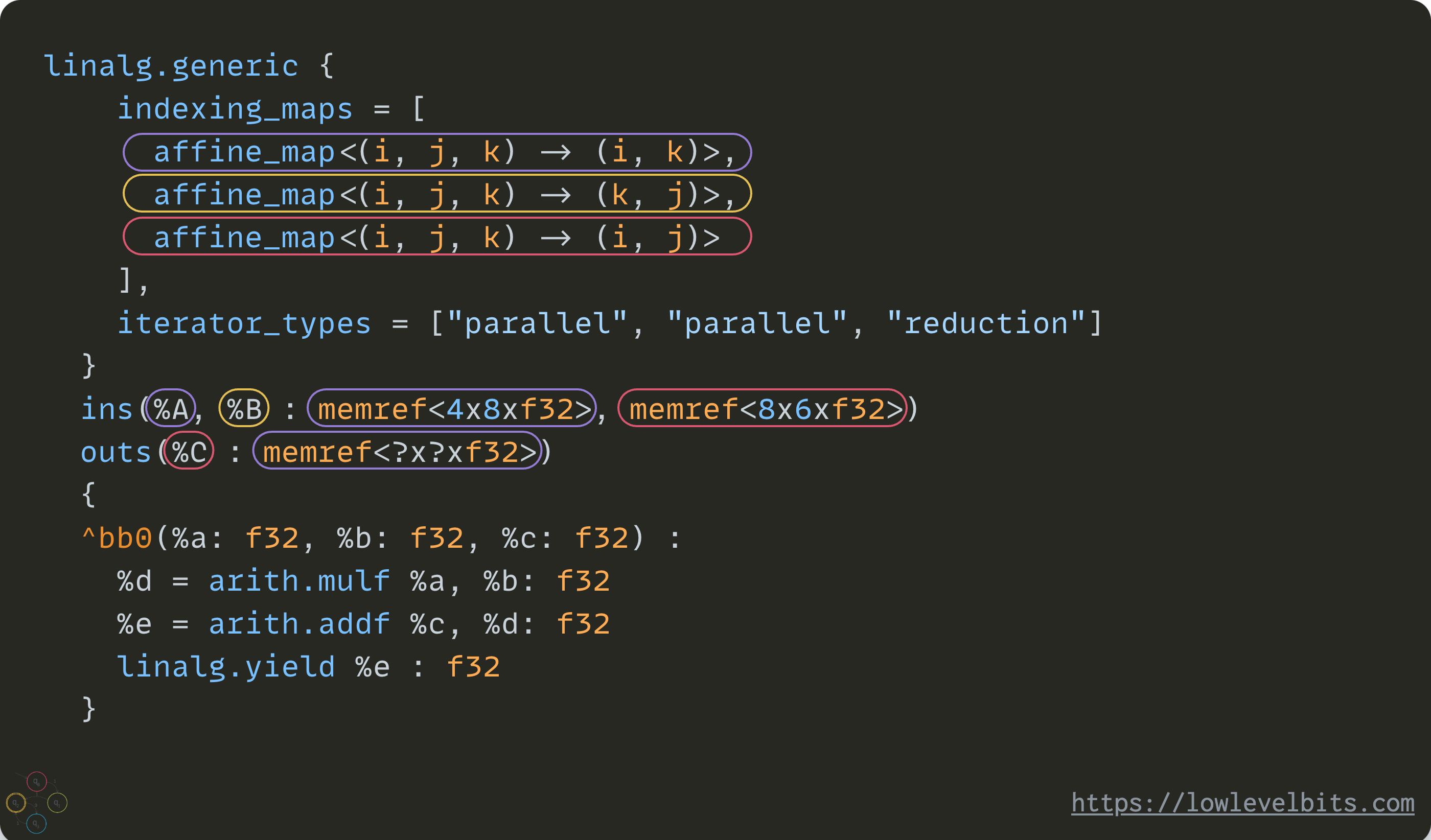
In other words, each “symbol” from an affine map corresponds to the dimensions of an operand, and thus the upper bound of each nested loop is determined by those dimensions:
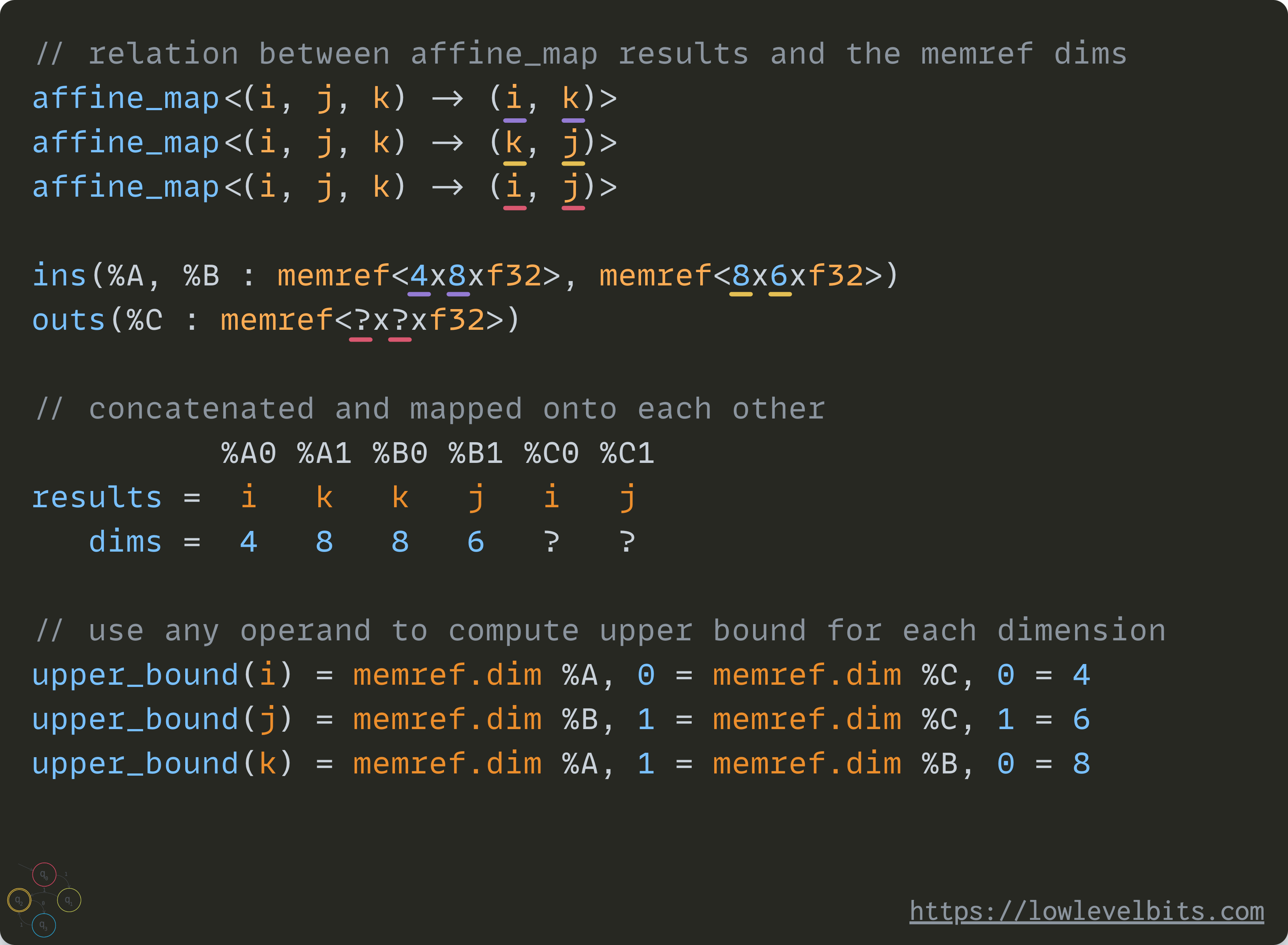
The mapping must be consistent, i.e. the dims of each results must be equal:
kequals 8 at both entriesiequals to 4 or?, or simply 4and
jequals 6 or?, or simply 6
Thus, even though %C has dynamic shape only known at run time, at compile time we can deduce that its only valid shape is 4x6 .
Converting linalg.generic to loops
Given the information above we can now convert any linalg.generic into loops by hand. To convert a linalg.generic to an scf.for loop we need to take several steps:
determine the number of nested loops
determine the upper bounds for each nested loop
create the nested loops with a corresponding induction variable and a corresponding upper bound
“remap” the loop nest arguments into
memref.loads based on the induction variables (and indexing maps)copy the original loop body
replace the terminating
linalg.yieldwithmemref.stores
Let’s consider a matmul example again, now with all the shapes being dynamic and only known at run time.
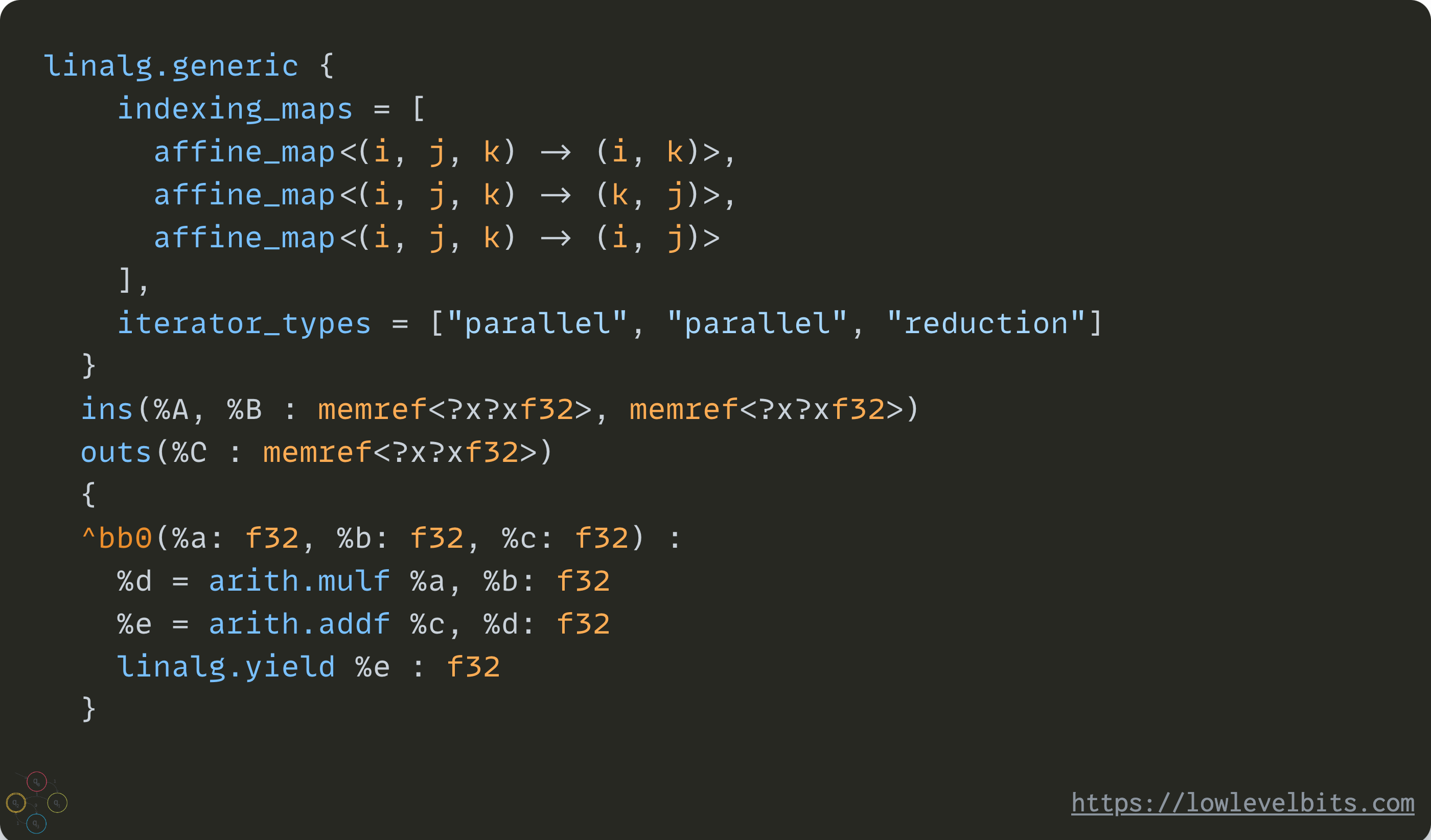
This operation has three nested loops with induction variables %i, %j, %k , each loop has a corresponding upper bound:
%i_ub = memref.dim %A, 0%j_ub = memref.dim %B, 1%k_ub = memref.dim %A, 1
Loop nest arguments %a, %b, %c are loaded from the corresponding ins and outs %A, %B, %C based on the indexing maps:
%a = memref.load %A[%i, %k]%b = memref.load %B[%k, %j]%c = memref.load %C[%i, %j]
The loop nest stays the same, except the final linalg.yield is replaced by a store:memref.store %c, %C[%i, %j] .
Stitching it all together we have the following implementation:
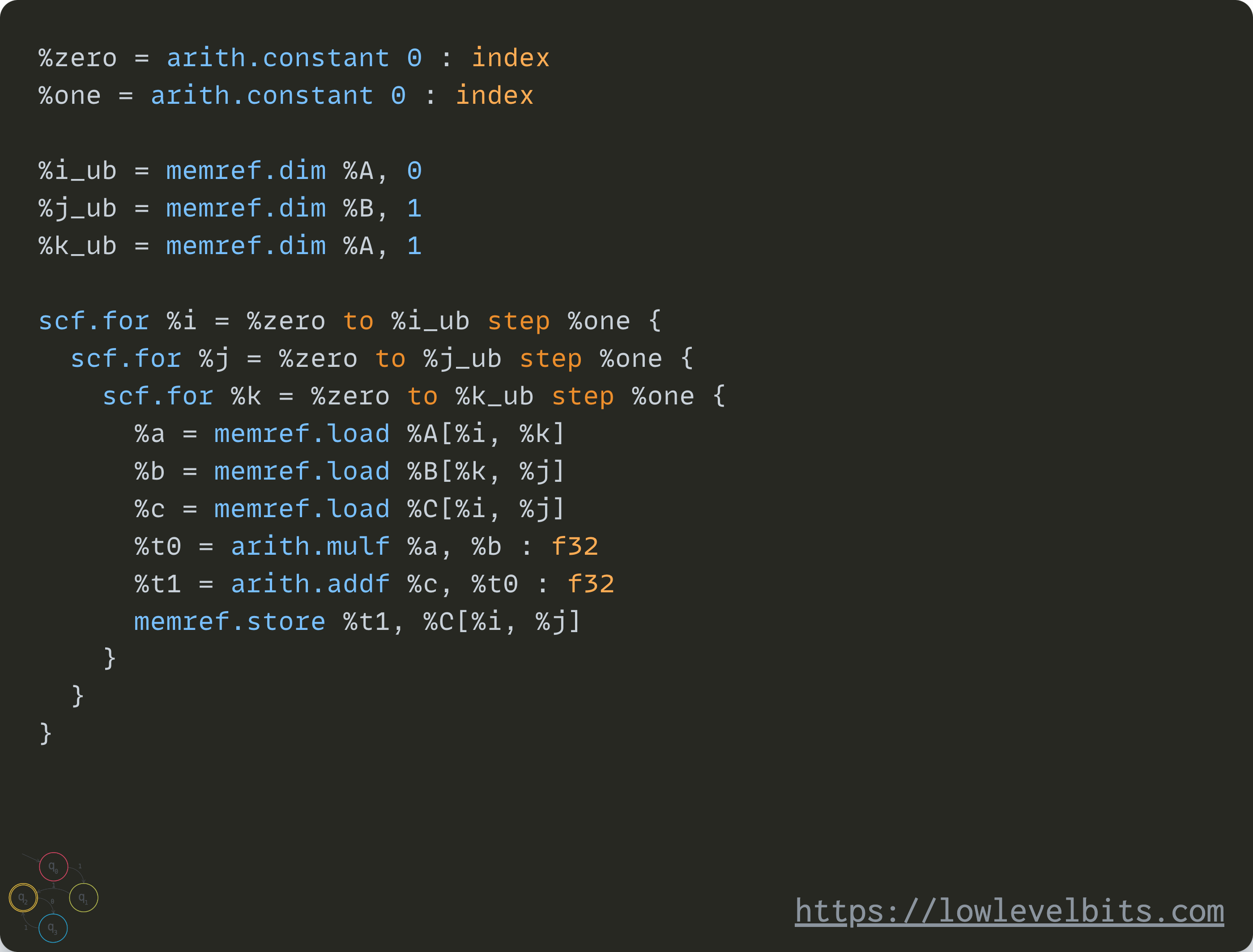
You can also see in action on Compiler Explorer.
Missing bits
There are a few details that I omitted for brevity, from the top of my head:
“syntactic sugar” aka named/elementwise operations
important non-generic operations such as
linalg.pack/unpack, linalg.index, and some morethe indexing maps view is a simplified one: the maps are a bit more involved and not always simple index mappings, e.g. there could be constants or arithmetic operations
linalg.genericoperands are not alwaysmemrefsortensorsunranked tensors/memrefs (though they are not relevant for
linalgdialect)
Perhaps there are some more topics I missed, but I hope with the information above you can go and fill in the gaps on your own.
Do not hesitate reaching out if you find mistakes or plain wrong claims in the article.